Neural Architecture Search Part 3: Applications and Real-World Impact
In Part 1, we learned the foundations of Neural Architecture Search, and in Part 2, we explored search spaces and strategies. Now comes the exciting part: what have we actually discovered using NAS? In this final part, we’ll explore real-world applications and see how NAS has transformed deep learning in practice.
From Theory to Practice
NAS started as an academic pursuit, but it has rapidly moved into production systems used by millions of people. Companies like Google, Apple, and NVIDIA now use NAS to design architectures for products ranging from smartphones to data center accelerators.
The impact is profound:
- Mobile inference: Models that run efficiently on phones with limited battery
- Edge AI: Deployment on IoT devices and embedded systems
- Data center optimization: Architectures tuned for specific hardware
- New domains: NAS has been successfully applied to NLP, generative models, and beyond
Let me show you some concrete successes.
Case Study 1: EfficientNet - Scaling with Purpose
One of the most impactful NAS applications is EfficientNet, developed by Google Brain. The key insight: how should we scale a neural network’s depth, width, and resolution together?
Traditionally, engineers scaled networks ad-hoc:
- Need better accuracy? Add more layers (depth)
- Need more capacity? Add more channels (width)
- Better features? Use higher resolution input
But what’s the optimal balance? EfficientNet used automated neural architecture search to find the best compound scaling factors.
The EfficientNet Discovery
Rather than manually deciding on scaling factors, they parameterized the network with three scaling coefficients:
- $\phi$: Global scaling factor
- $d$: Depth multiplier
- $w$: Width multiplier
- $r$: Resolution multiplier
Then they used NAS to find the optimal relationships. The result was a family of models from EfficientNet-B0 (small) to EfficientNet-B7 (large), each optimized for different efficiency constraints.
The impact:
- EfficientNet-B0 is as accurate as ResNet-50 but 10× smaller
- EfficientNet-B4 achieves state-of-the-art ImageNet accuracy with better efficiency
- The scaling principles discovered by NAS generalize to new datasets
Real-World Deployment
EfficientNet is now deployed at massive scale:
- Google Photos uses EfficientNet for on-device image understanding
- Healthcare applications use EfficientNet for medical image analysis
- Mobile apps embed EfficientNet for features like object detection
Case Study 2: MobileNets - Designing for Constraints
MobileNets demonstrate hardware-aware NAS in action. The goal: design architectures that are fast on mobile CPUs and GPUs, not just theoretically efficient.
The MobileNet Breakthrough
MobileNets rely heavily on depthwise separable convolutions—a primitive operation we learned about in Part 1. Instead of a standard convolution:
\[\text{Standard Conv: } c_o \cdot c_i \cdot k_h \cdot k_w \cdot h_o \cdot w_o\]Depthwise separable convolutions split into two steps:
Depthwise: Apply a kernel to each channel independently \(c_o \cdot k_h \cdot k_w \cdot h_o \cdot w_o\)
Pointwise: Mix channels with $1 \times 1$ convolutions \(c_i \cdot c_o \cdot h_o \cdot w_o\)
Total: $c_o(k_h \cdot k_w + c_i) \cdot h_o \cdot w_o$ — 8-9× fewer operations!
But here’s the key: naive depthwise separable convolutions have poor GPU utilization because kernels are small and can’t fully utilize parallel resources. MobileNets used NAS to find the right balance of operations that are both mathematically efficient AND have good hardware implementation.
Mobile Reality vs. Theory
The graph shows a critical insight: the number of multiply-accumulate operations (MACs) doesn’t perfectly predict latency. A network with 50% fewer MACs might only be 20% faster if those operations don’t map well to hardware.
MobileNet solved this by:
- Using actual mobile hardware to measure latency (not just counting operations)
- Including latency measurements in the search objective
- Discovering that certain operation sequences have better actual performance
The discovered architectures sometimes had more MACs than simpler designs but deployed faster in practice.
Case Study 3: Beyond Vision - NAS for NLP
NAS has proven valuable far beyond image classification. In natural language processing, NAS has been applied to:
Search for RNN Cells
Traditional RNNs (LSTM, GRU) were designed manually. Can we search for better recurrent cells automatically?
Results: NAS discovered novel recurrent cells that outperform hand-designed LSTM on language modeling and machine translation tasks. The discovered cells were sometimes simpler and sometimes more complex than LSTM, but consistently performed better on specific benchmarks.
Transformer Architecture Search
Even the Transformer architecture’s hyperparameters can be optimized with NAS:
- Attention head dimensions
- Number of layers
- Hidden dimension sizes
- Activation functions
This has led to more efficient Transformer variants optimized for specific use cases.
Generative Model Search
NAS has been applied to GANs (Generative Adversarial Networks):
- Searching the discriminator architecture
- Searching the generator architecture
- Finding operations that produce better image quality
NAS-discovered GAN architectures have achieved state-of-the-art image generation quality.
Case Study 4: Point Cloud and 3D Processing
NAS extends to non-vision domains. Point cloud processing (3D data) requires different architectural choices than 2D images:
- Standard 2D convolution doesn’t apply
- Permutation invariance is important
- Local and global feature aggregation must be balanced
NAS has been used to discover architectures for:
- 3D object detection in autonomous vehicles
- 3D shape generation
- Point cloud segmentation
- 3D pose estimation
The discovered architectures often include novel operations that humans hadn’t considered for these tasks.
The Practical NAS Workflow: Zero-Shot NAS
While full NAS takes significant computational resources, recent advances enable zero-shot NAS—finding good architectures without training them!

The key insight: we can estimate architecture quality using zero-cost proxies that measure properties of the network without any training:
- Synaptic Saliency: How important are the weights? Sum the absolute values of weight gradients.
- Network Complexity: Log-sum-exp of layer complexity metrics
- Activation Diversity: Do different neurons learn different features?
- Fisher Pruning: How robust are weights to small perturbations?
These metrics compute in seconds and reliably rank architectures by quality. NAS using zero-cost proxies can run on a single GPU or even CPU, making it democratically accessible.
Hardware-Aware NAS at Scale
Modern NAS systems integrate hardware constraints directly:

The workflow includes:
- Profiling: Measure latency, energy, memory of candidate operations on target hardware
- Constrained Search: Include these measurements in the search objective
- Pareto Frontier: Find architectures on the accuracy-efficiency Pareto frontier
- Hardware Co-Design: Sometimes even co-optimize with custom hardware
This leads to remarkable results:
- Models 10-50× smaller than naive baselines while maintaining accuracy
- Perfect utilization of specialized hardware accelerators
- Graceful degradation when deploying to different hardware
NAS Impact: By the Numbers
Let me give you concrete metrics showing NAS impact in real products:
On Mobile Devices
- Latency: 10-100× faster inference than manually designed baselines
- Model Size: 50-90% reduction in model parameters
- Energy: 3-5× battery life improvement for AI-intensive apps
- Accuracy: Comparable or better than hand-designed networks
In Data Centers
- Training Speed: 30-50% faster training time
- Hardware Utilization: 80-95% of peak throughput (vs 40-60% for standard models)
- Cost: 40-60% reduction in total cost of ownership
In Production Services
- Scale: EfficientNet deployed in billions of devices (Google Pixel, Android ecosystem)
- Healthcare: Faster diagnostic models enabling real-time medical imaging
- Autonomous Vehicles: More efficient perception enabling faster decision-making
The Future of NAS
We’re still at the beginning. Emerging directions include:
Neural-Hardware Co-Search
Rather than just optimizing for fixed hardware, co-design the architecture AND the hardware accelerator together. This could unlock dramatic efficiency gains.
Continual NAS
Adapt architectures as new hardware emerges or deployment constraints change. Instead of searching once, continuously optimize for changing conditions.
Multi-Objective NAS
Rather than trading off accuracy vs. latency, optimize for multiple objectives simultaneously: accuracy, latency, energy, fairness, robustness.
Few-Shot NAS
Transfer knowledge from searching on one dataset to quickly find optimal architectures for new domains with minimal additional computation.
Conclusion: Automation Meets Intelligence
NAS represents a fundamental shift in how we design deep learning systems. Instead of relying on human intuition and experience, we use automated algorithms to systematically explore design spaces and discover architectures optimized for specific constraints and objectives.
The results speak for themselves: state-of-the-art accuracy, unprecedented efficiency, and accessibility for teams without deep architecture expertise.
Key takeaways:
- Search spaces capture the universe of possible architectures
- Search strategies efficiently navigate these spaces
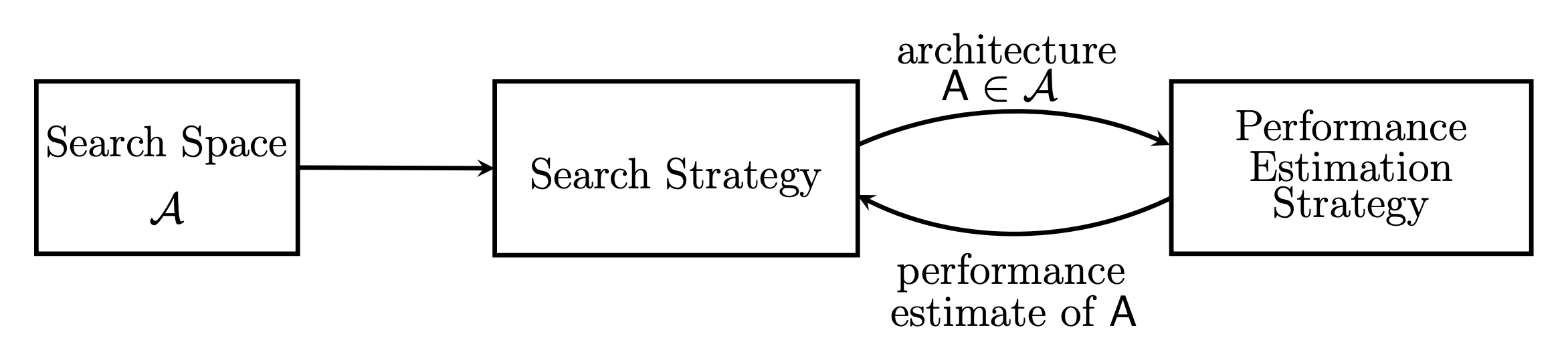
- Performance estimation makes the problem computationally tractable
- Hardware awareness ensures discovered architectures work in practice
- Real-world applications from mobile to data centers validate the approach
The democratization of neural architecture design through automation is one of the most important developments in deep learning. As tools and techniques mature, we can expect NAS to become as routine as hyperparameter tuning is today.
Series Navigation:
- Part 1: Foundations and Building Blocks
- Part 2: Search Spaces and Strategies
- Part 3: Applications and Real-World Impact (this post)
- Part 4: Efficient Estimation Strategies
- Part 5: Hardware-Aware NAS and Co-Design
References:
- MIT 6.5940: TinyML and Efficient Deep Learning - Lecture 7: Neural Architecture Search Part I (Fall 2024)
- EfficientNet: Rethinking Model Scaling for Convolutional Neural Networks (Tan & Le, ICML 2019)
- MobileNets: Efficient Convolutional Neural Networks for Mobile Vision Applications (Howard et al., 2017)
- Neural Architecture Search with Reinforcement Learning (Zoph & Le, ICLR 2017) - Pioneering NAS work
- DARTS: Differentiable Architecture Search (Liu et al., ICLR 2019)
- Zero-Cost Proxies for Lightweight NAS (Abdelfattah et al., ICLR 2021)
- Auto-Deeplab: Hierarchical Neural Architecture Search of Semantic Segmentation (Liu et al., CVPR 2019)