Neural Network Pruning Part 1: Why Pruning Matters
The Growing Challenge of Model Size
Imagine building a house and ordering 10,000 bricks, but you only use 2,000 of them. The remaining 8,000 bricks sit in your yard, taking up space, costing money, and serving no purpose. This is exactly what happens with modern neural networks—they’re massively over-parameterized.
The Exponential Growth of AI Models
Deep learning models have grown exponentially over the years. Let’s look at how model sizes have exploded:
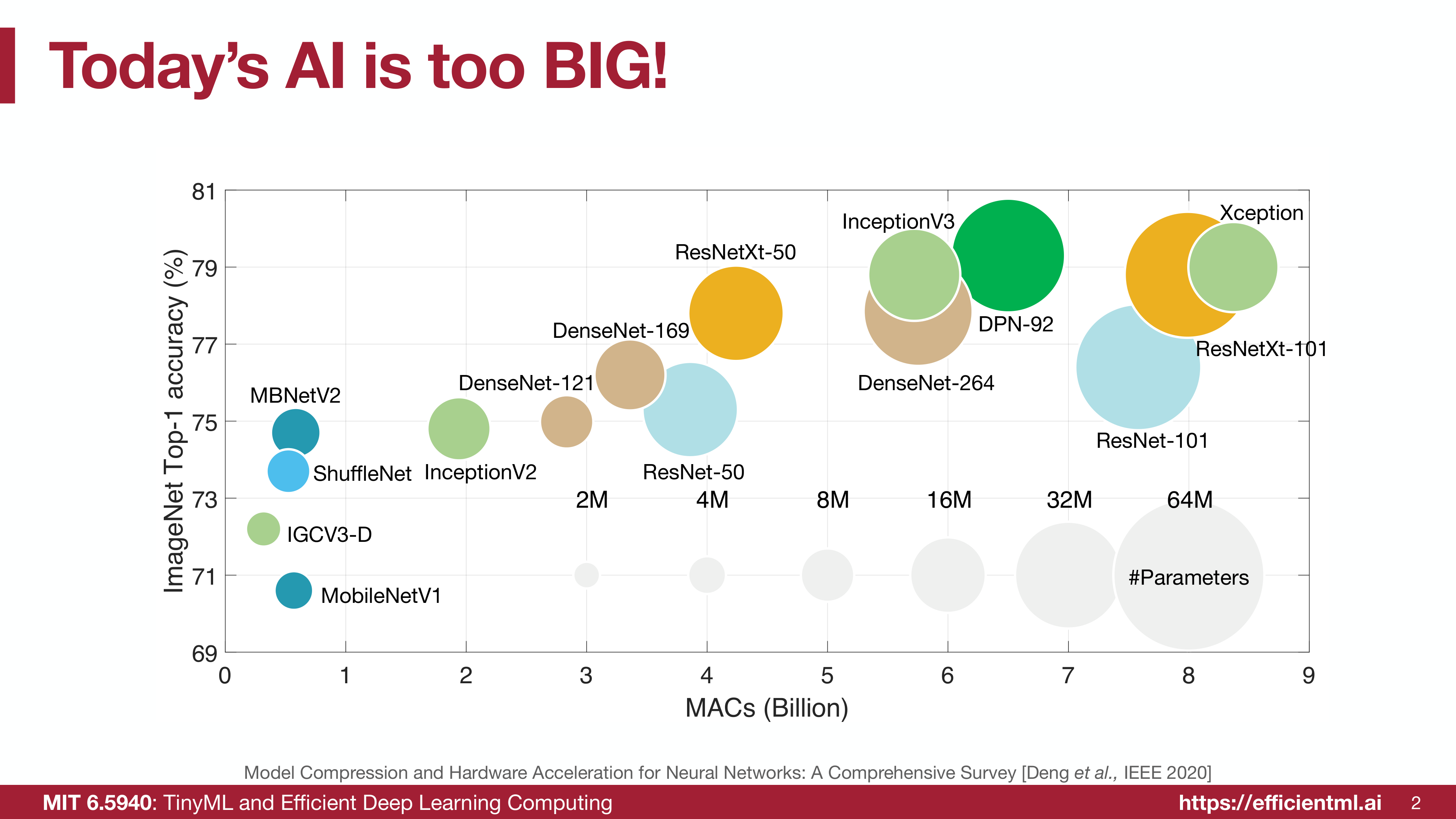
Model size vs accuracy: Larger models don't always mean better performance
The Evolution of Model Sizes:
| Model | Year | Parameters | Approximate Size |
|---|---|---|---|
| LeNet-5 | 1998 | <1M | ~4 MB |
| AlexNet | 2012 | 61M | ~240 MB |
| VGG-16 | 2014 | 138M | ~528 MB |
| ResNet-50 | 2015 | 26M | ~100 MB |
| GPT-3 | 2020 | 175B | ~700 GB |
| GPT-4 | 2023 | ~1.7T | ~7 TB (estimated) |
Why This Growth is Problematic
The Supply-Demand Gap:
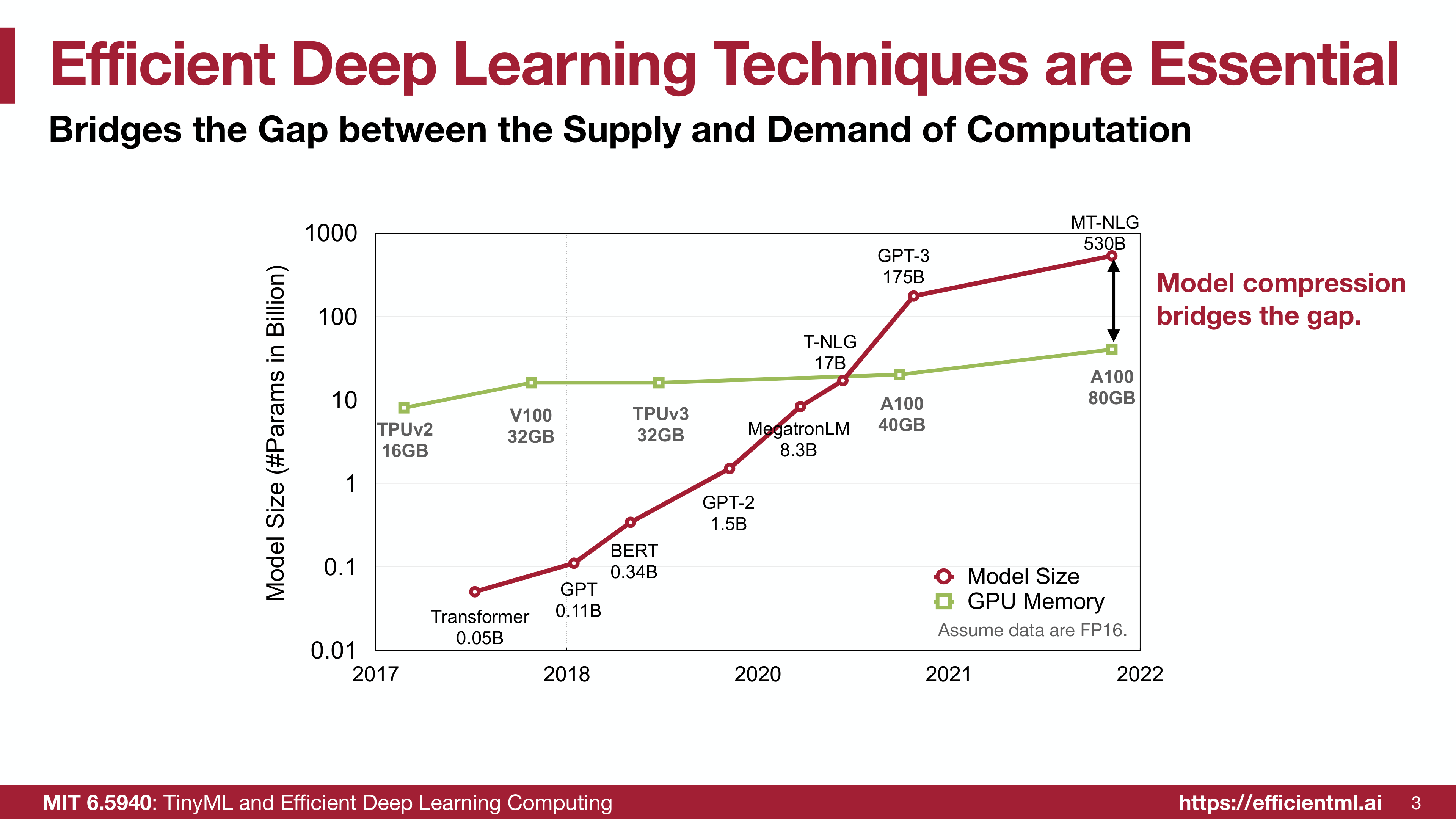
Model sizes are growing faster than GPU memory capacity
The graph above shows a critical problem: model sizes are growing exponentially faster than available GPU memory. Even the most advanced GPUs struggle to keep up:
- A100 GPU (2020): 80 GB memory
- GPT-3 (2020): 175B parameters ≈ 700 GB (in FP16)
- MT-NLG (2021): 530B parameters ≈ 2.1 TB (in FP16)
This means we can’t even load these models into a single GPU, let alone train or run inference efficiently.
What is Neural Network Pruning?
Pruning is the process of removing unnecessary connections (weights) and neurons from a neural network to make it smaller and faster, without significantly hurting its performance.
Inspiration from the Human Brain
Neural network pruning isn’t just a computational trick—it’s inspired by how our own brains develop:
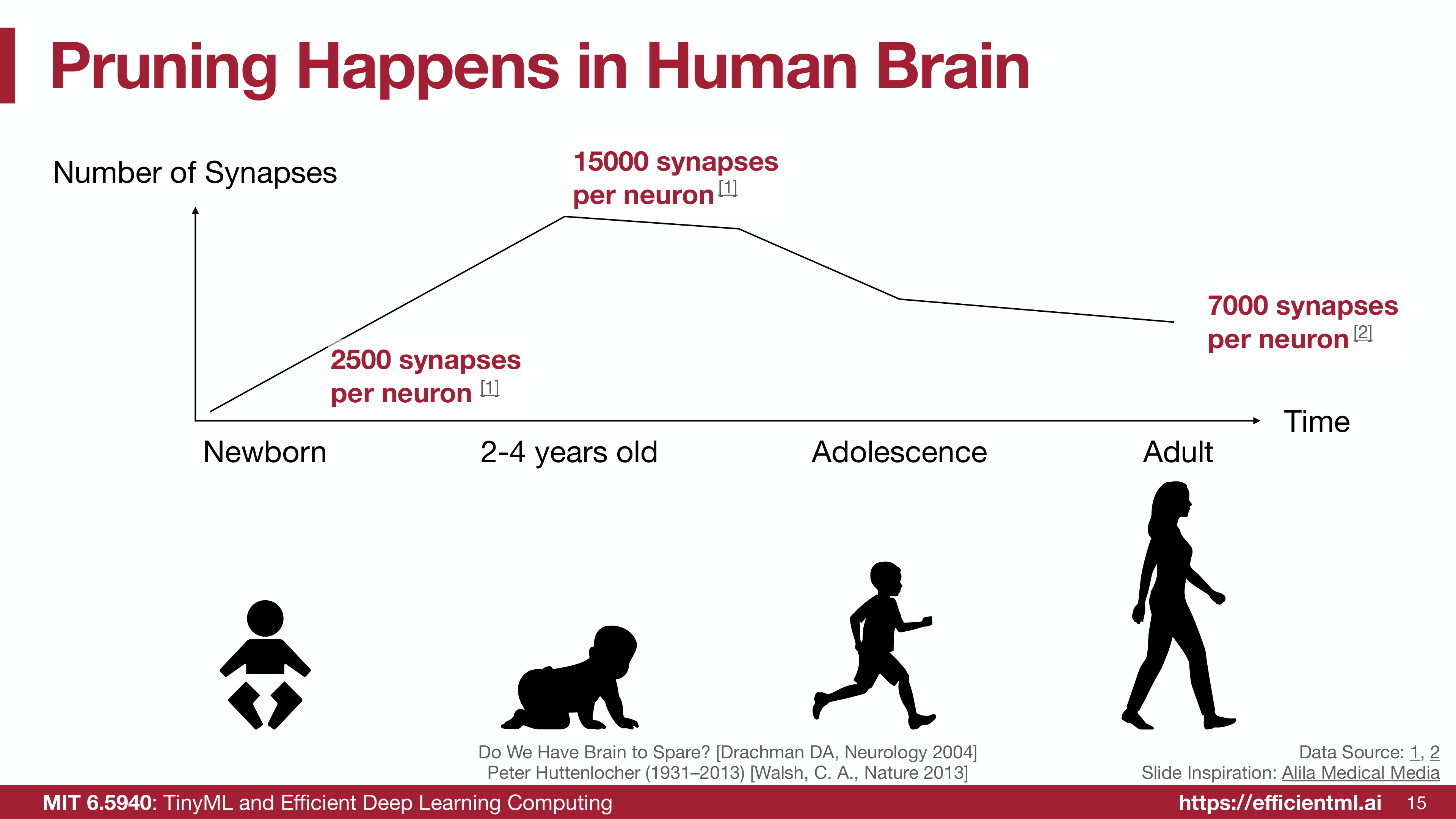
Synapse development in the human brain from birth to adulthood
Human Brain Development:
- Newborn: ~2,500 synapses per neuron
- 2-4 years: ~15,000 synapses per neuron (peak)
- Adolescence: Pruning begins
- Adult: ~7,000 synapses per neuron (53% reduction!)
The human brain naturally prunes connections that aren’t frequently used. This process makes our brain more efficient without reducing our cognitive abilities. In fact, this pruning is essential for healthy brain development.
The Simple Idea Behind Pruning
Think of a neural network like a city’s road network:
- Some roads (connections) carry heavy traffic daily
- Other roads are rarely used
- Removing rarely-used roads saves maintenance costs without affecting most people’s commutes
Similarly, in neural networks:
- Some weights contribute significantly to predictions
- Many weights are close to zero or contribute minimally
- Removing these “weak” connections reduces model size without hurting accuracy
Why Should We Care About Pruning?
1. Energy Efficiency
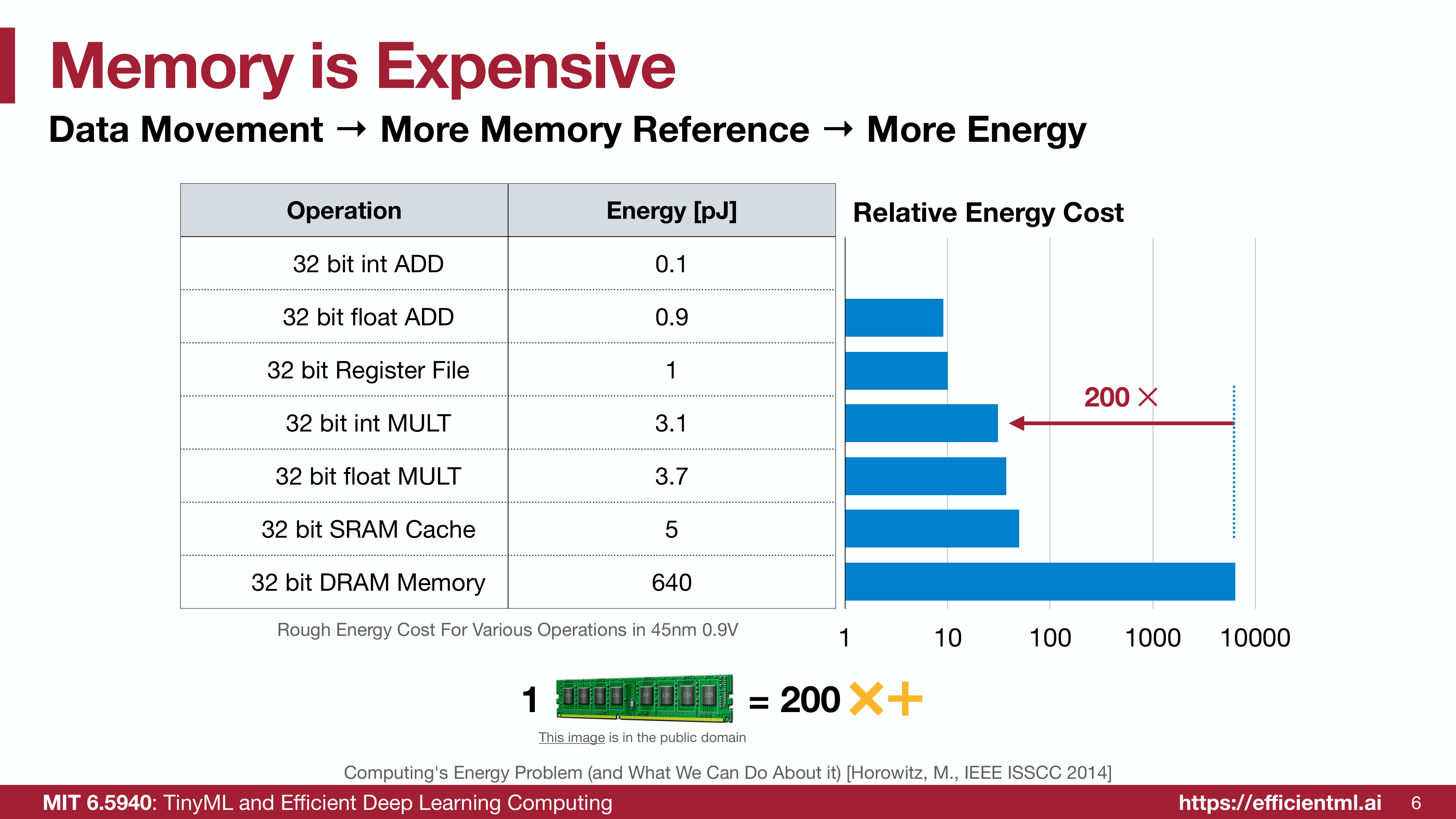
Energy cost comparison for different computing operations in 45nm CMOS
Memory access is incredibly expensive in terms of energy:
| Operation | Energy Cost (pJ) | Relative Cost |
|---|---|---|
| 32-bit INT Addition | 0.1 | 1× |
| 32-bit FP Addition | 0.9 | 9× |
| 32-bit Register File | 1 | 10× |
| 32-bit INT Multiply | 3.1 | 31× |
| 32-bit FP Multiply | 3.7 | 37× |
| 32-bit SRAM Cache | 5 | 50× |
| 32-bit DRAM Memory | 640 | 6,400× |
Key Insight: Reading from DRAM (external memory) costs 200 times more energy than reading from on-chip SRAM cache. Smaller models fit in faster, more energy-efficient memory.
2. Real-World Impact
Mobile Deployment:
- Running a 1 billion parameter network at 20 Hz requires: $(20 \text{ Hz}) \times (1B) \times (640 \text{ pJ}) = 12.8 \text{ W}$
- This is beyond the power budget of most mobile devices
- A 10× pruned model would require only ~1.3W—much more feasible!
Cloud Costs:
- Smaller models mean more inferences per GPU
- Reduced memory bandwidth requirements
- Lower electricity costs for data centers
Environmental Impact:
- Training large models produces significant CO₂ emissions
- Pruned models require less compute, reducing carbon footprint
- More efficient inference at scale
3. Practical Benefits
Faster Inference: Fewer operations mean faster predictions
Lower Latency: Critical for real-time applications
Reduced Storage: Easier model deployment and updates
Better Accessibility: Run powerful models on edge devices
Cost Savings: Fewer GPUs needed for serving models
How Effective is Pruning?
Pruning can dramatically reduce model size with minimal accuracy loss:
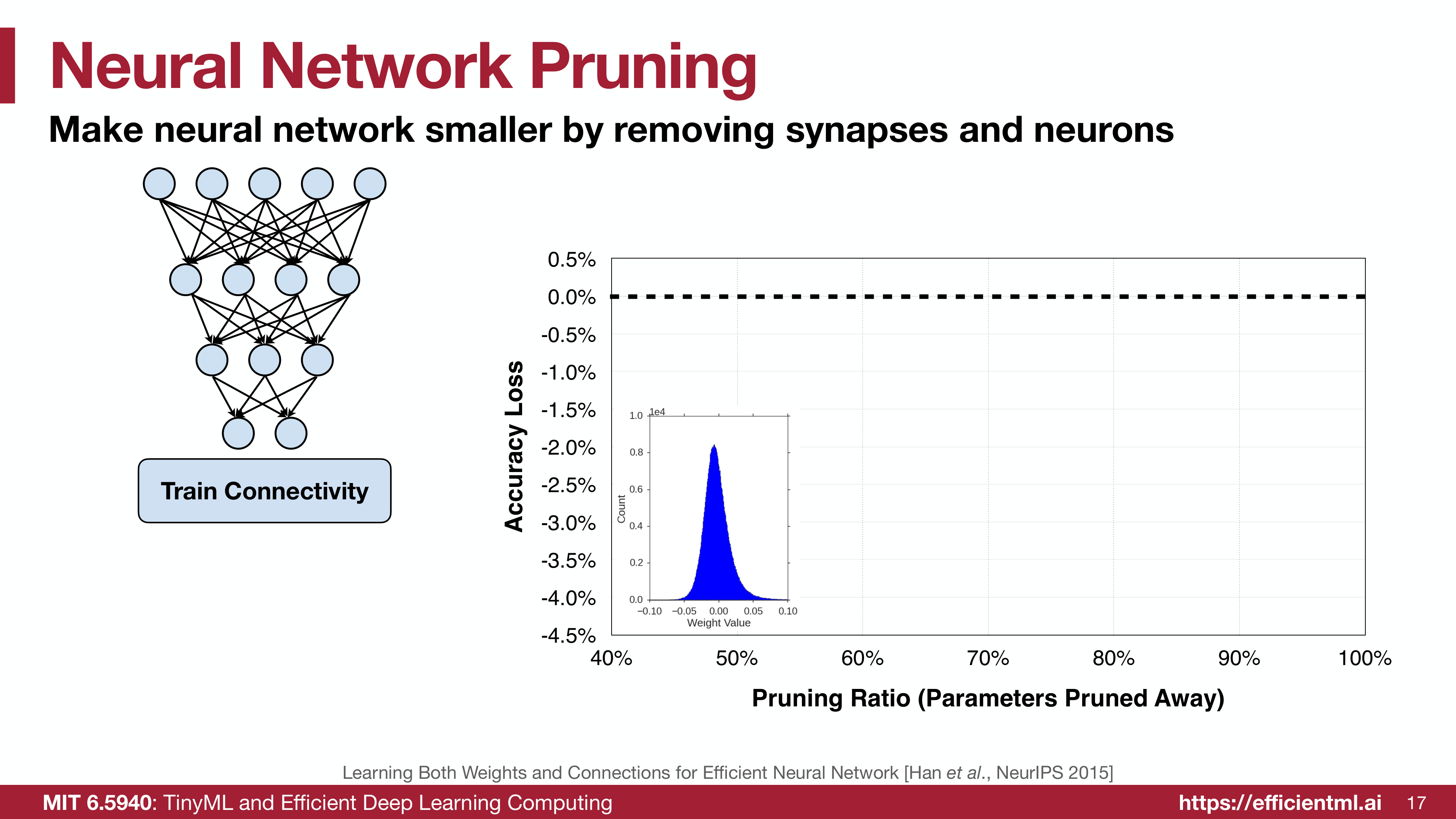
Accuracy loss vs pruning ratio showing that models can maintain accuracy even with 80-90% pruning
The graph above shows that:
- Up to 50% of parameters can be pruned with no accuracy loss
- 70-80% pruning still maintains acceptable accuracy
- With proper fine-tuning (iterative pruning), even 90% pruning is possible!
Real Results from Research:
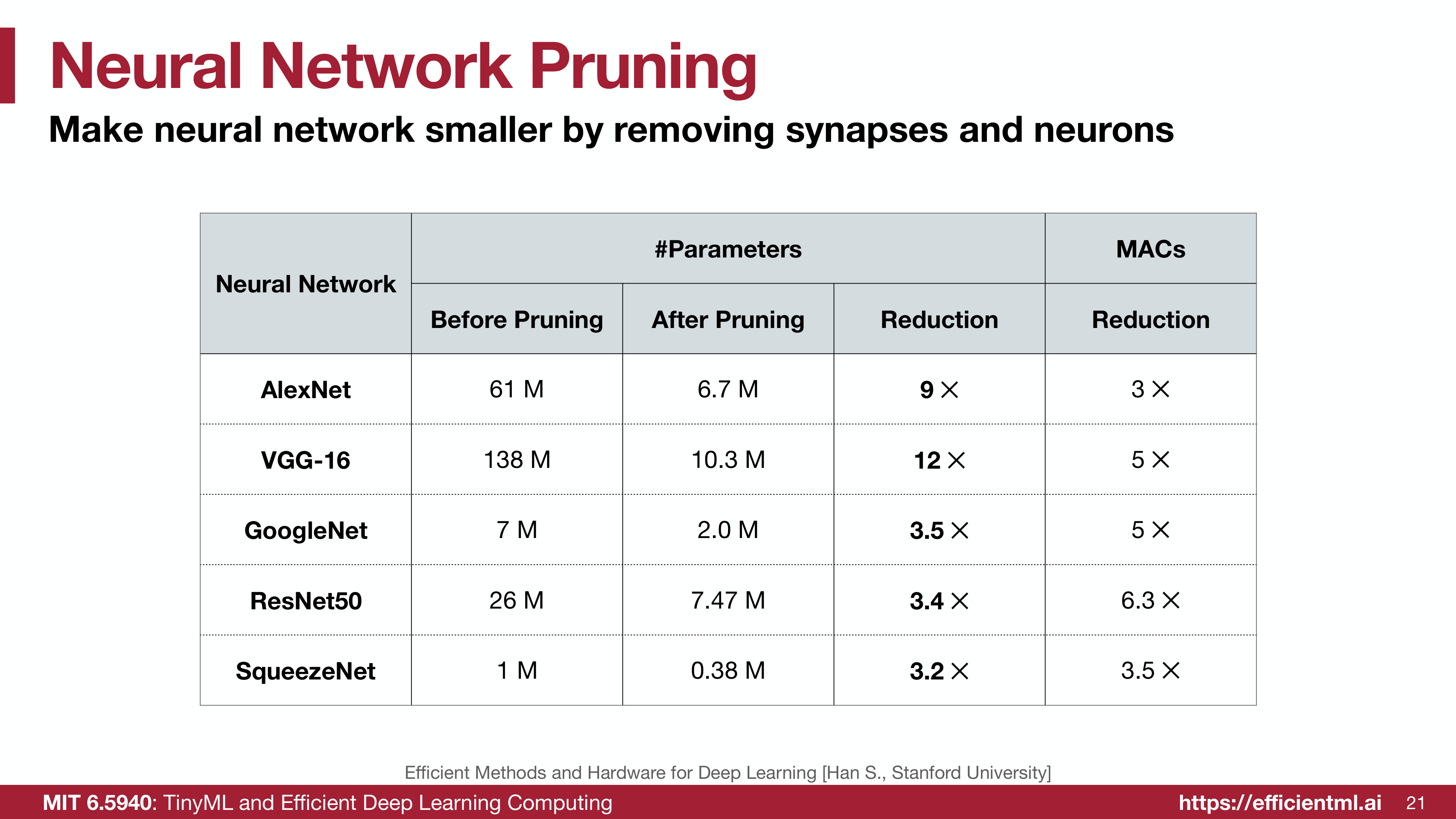
Compression ratios achieved on popular neural networks
| Network | Original Params | Pruned Params | Reduction | MAC Reduction |
|---|---|---|---|---|
| AlexNet | 61M | 6.7M | 9× | 3× |
| VGG-16 | 138M | 10.3M | 12× | 5× |
| GoogLeNet | 7M | 2.0M | 3.5× | 5× |
| ResNet-50 | 26M | 7.47M | 3.4× | 6.3× |
| SqueezeNet | 1M | 0.38M | 3.2× | 3.5× |
This means we can make AlexNet 9× smaller while keeping the same accuracy on ImageNet!
What is Pruning NOT?
Let’s clarify some misconceptions:
Not about reducing model architecture complexity (like switching from ResNet-50 to MobileNet)
Not about quantization (using lower precision like INT8 instead of FP32)
Not about knowledge distillation (training a smaller model to mimic a larger one)
IS about selectively removing parameters from an existing, trained model
Real-World Applications
Pruning is not just academic—it’s being used in production:
Industry Adoption
NVIDIA GPUs (A100 and newer) have hardware support for structured sparsity:
- 2:4 sparsity pattern: 50% of weights are zero
- Delivers 2× theoretical speedup
- Achieves ~1.5× measured speedup on BERT inference
MLPerf Results (2024):
- Pruned Llama 2 70B achieved 2.5× speedup while maintaining 99% accuracy
- Used depth pruning (80 → 32 layers) and width pruning (28,762 → 14,336 dimensions)
Key Takeaways
- Model sizes are growing exponentially, outpacing hardware improvements
- Memory access dominates energy consumption, not computation
- Neural networks are highly redundant—many parameters contribute little
- Pruning can reduce model size by 3-12× without accuracy loss
- The human brain naturally prunes connections, and it works remarkably well
- Industry is adopting pruning with hardware support and production deployments
What’s Next?
Now that we understand why pruning matters, the natural questions are:
- How do we actually prune a neural network?
- Which connections should we remove?
- What patterns of pruning work best?
In Part 2, we’ll explore different pruning granularities—from removing individual weights to entire channels—and understand the trade-offs between compression ratio and hardware efficiency.
Series Navigation:
- Part 1: Why Pruning Matters (Current)
- Part 2: Pruning Granularities
- Part 3: Pruning Criteria
- Part 4: Advanced Techniques
References:
- MIT 6.5940: TinyML and Efficient Deep Learning (Fall 2024)
- Learning Both Weights and Connections for Efficient Neural Network (Han et al., NeurIPS 2015)
- Computing’s Energy Problem (and What We Can Do About it) (Horowitz, IEEE ISSCC 2014)
- Model Compression and Hardware Acceleration: A Comprehensive Survey (Deng et al., IEEE 2020)