Quantization Part 1: Understanding Numeric Data Types
Neural network quantization has emerged as one of the most effective techniques for making deep learning models efficient enough to run on resource-constrained devices. But before diving into quantization methods, we need to understand how computers represent numbers in the first place. This foundational knowledge will illuminate why quantization works and how different numeric formats impact both model size and computational efficiency.
The Energy Crisis in Deep Learning
Modern deep learning models are becoming increasingly power-hungry. Consider a simple mathematical operation: multiplying two 32-bit floating-point numbers consumes approximately 3.7 picojoules (pJ) of energy, while the same operation with 8-bit integers uses only 0.2 pJ—an 18.5× reduction. Similarly, 32-bit floating-point addition costs 0.9 pJ compared to just 0.03 pJ for 8-bit integer addition—a 30× improvement.
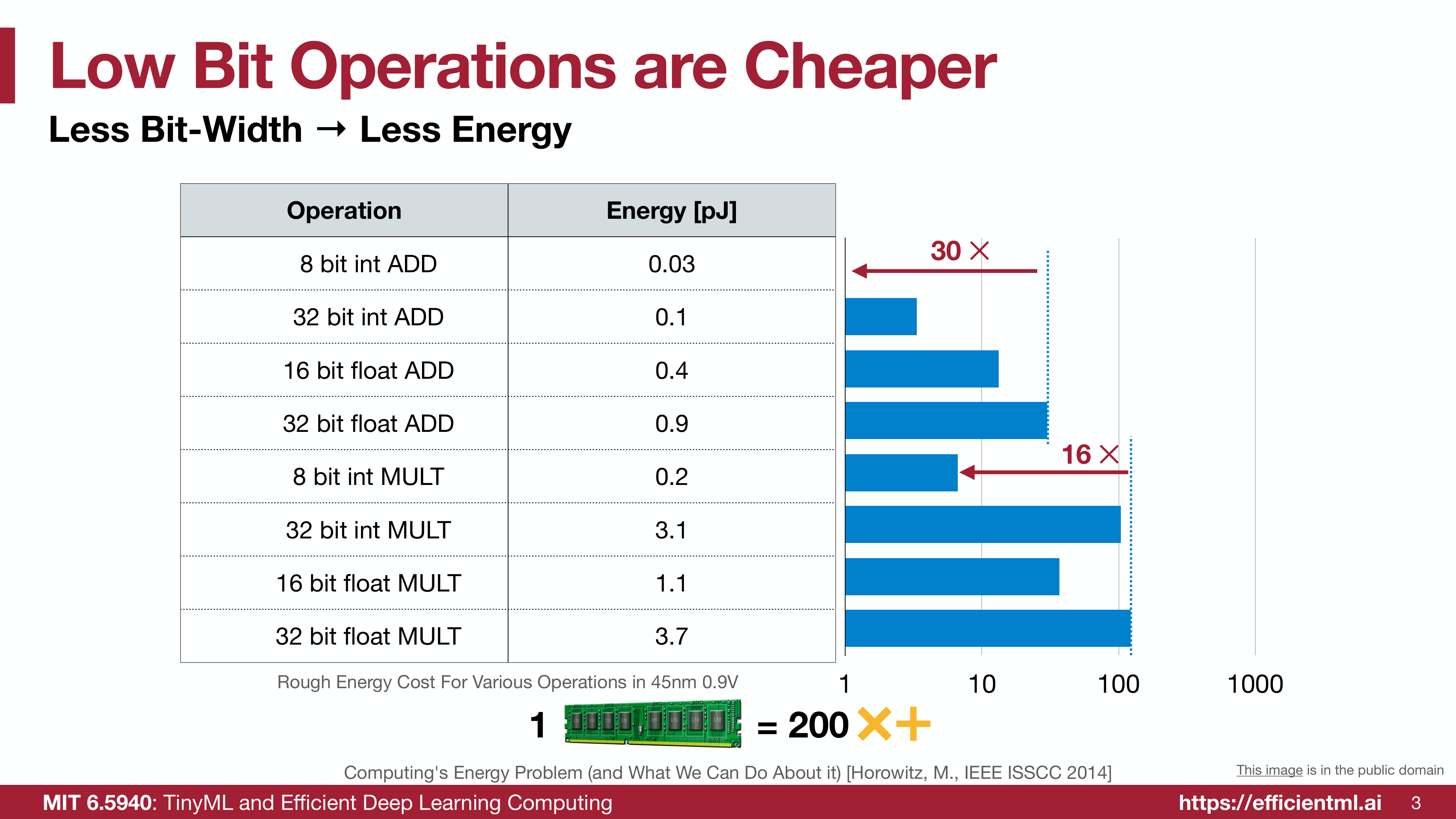 Energy consumption for various operations in 45nm 0.9V process
This dramatic difference isn’t just about raw numbers. When you multiply these savings across billions of operations in a neural network, the cumulative energy reduction becomes substantial. For mobile and edge devices running on battery power, this translates directly to longer battery life and reduced thermal constraints.
Integer Representations
Integers form the simplest numeric data type, representing whole numbers without fractional components. Modern computing systems use two primary representations.
Unsigned Integers
An unsigned n-bit integer can represent values from 0 to $2^n - 1$. For example, an 8-bit unsigned integer maps the binary pattern 00110001 to:
This straightforward representation works perfectly for counting and indexing operations where negative numbers aren’t needed.
Signed Integers with Two’s Complement
For representing both positive and negative numbers, computers use two’s complement representation. This clever encoding allows an n-bit signed integer to represent values from $-2^{n-1}$ to $2^{n-1} - 1$.
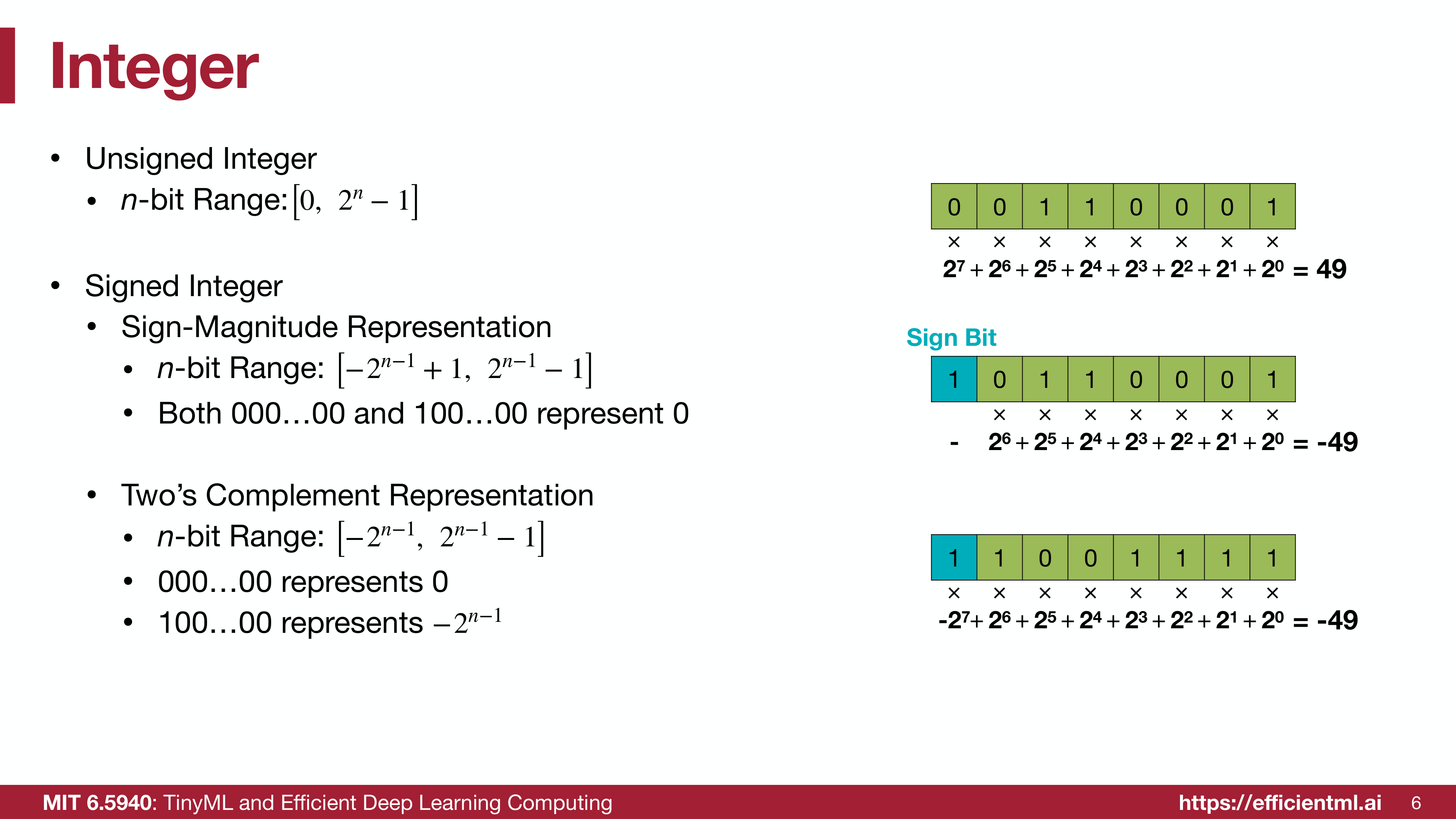 Different integer representations: unsigned, sign-magnitude, and two’s complement
The beauty of two’s complement lies in its arithmetic properties. Addition and subtraction operations work identically for signed and unsigned numbers, eliminating the need for separate hardware circuits. The most significant bit serves as the sign indicator: 0 for positive numbers and 1 for negative numbers.
For example, the binary pattern 11001111 in 8-bit two’s complement represents:
Fixed-Point Numbers
Fixed-point numbers extend integers to represent fractional values by designating some bits for the fractional part. Think of it as placing an imaginary decimal point at a fixed position within the bit pattern. An 8-bit fixed-point number with 4 integer bits and 4 fractional bits can represent values with precision up to $2^{-4} = 0.0625$.
The key limitation? The decimal point position never changes, restricting the representable range. This constraint becomes problematic for neural networks where values can span multiple orders of magnitude.
Floating-Point Number Fundamentals
Floating-point representation solves the range problem by allowing the “decimal” point to move dynamically—hence the name “floating” point. This flexibility makes it the standard choice for scientific computing and machine learning.
IEEE 754 Standard Architecture
The IEEE 754 standard defines how floating-point numbers are encoded in binary. A 32-bit float (FP32) consists of three components:
- Sign bit (1 bit): Determines positive (0) or negative (1)
- Exponent (8 bits): Represents the scale or magnitude
- Fraction/Mantissa (23 bits): Stores the precision
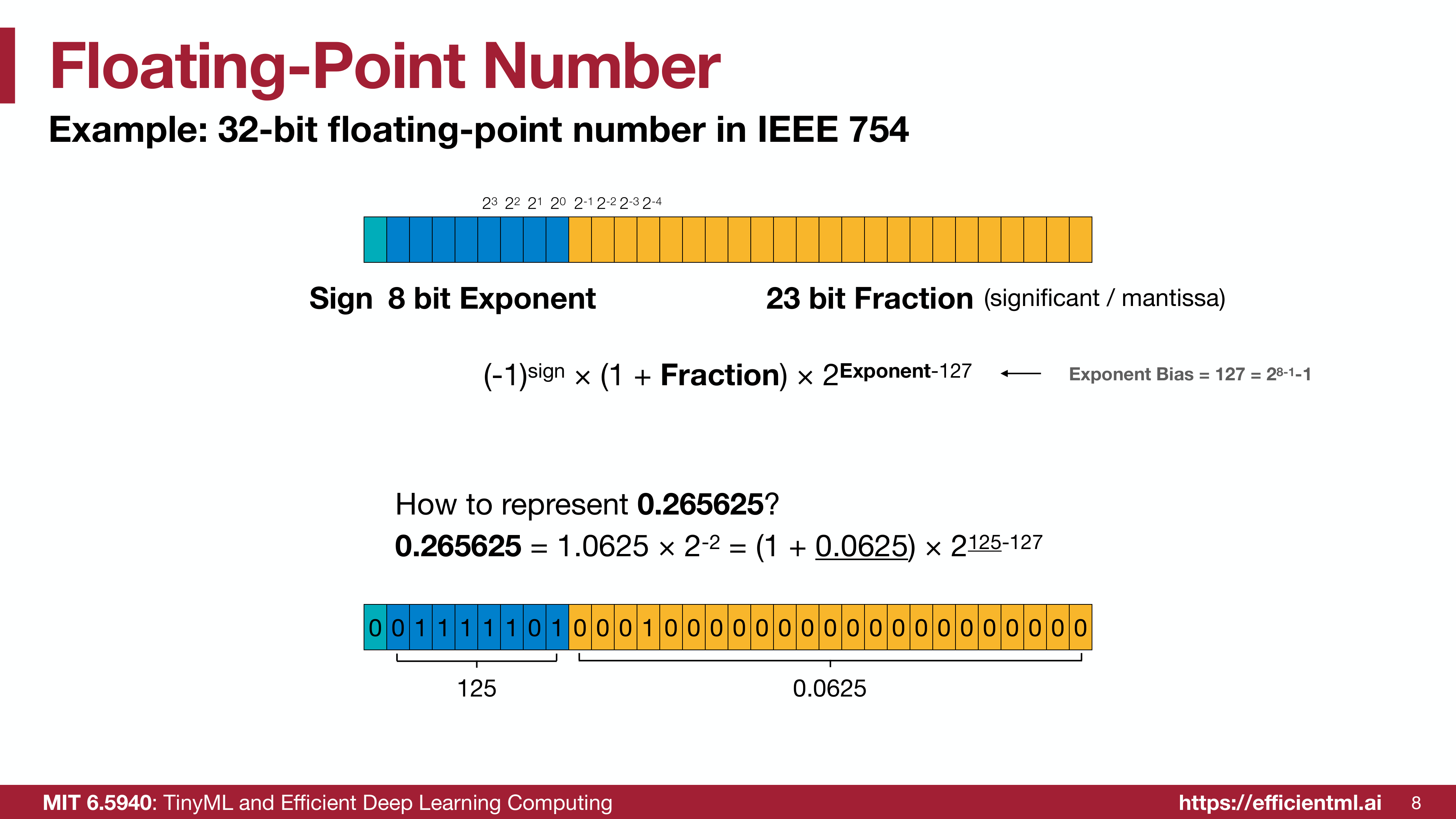 Anatomy of a 32-bit floating-point number in IEEE 754 format
The mathematical formula for a normal floating-point number is:
\[(-1)^{\text{sign}} \times (1 + \text{Fraction}) \times 2^{\text{Exponent} - 127}\]The exponent uses a bias of 127 (calculated as $2^{8-1} - 1$) to represent both positive and negative exponents using only unsigned arithmetic. This means an exponent field value of 127 represents $2^0 = 1$, while 130 represents $2^3 = 8$.
The fraction represents the decimal part after an implicit leading 1. This clever trick provides an extra bit of precision since the leading bit is always 1 for normal numbers (except for special cases).
Representing Edge Cases
IEEE 754 includes special representations for edge cases:
Zero: Both positive and negative zero exist, represented by exponent and fraction fields set to all zeros. The sign bit distinguishes between $+0$ and $-0$.
Subnormal numbers: When the exponent field is zero but the fraction is non-zero, the number is treated as subnormal, using the formula:
\[(-1)^{\text{sign}} \times \text{Fraction} \times 2^{1-127}\]This allows representation of extremely small numbers close to zero, maintaining gradual underflow instead of abrupt jumps.
Infinity and NaN: An exponent field of all ones indicates either infinity (when fraction is zero) or Not-a-Number (when fraction is non-zero), used for undefined operations like $0/0$.
Comparing Floating-Point Formats
Different applications require different trade-offs between range and precision. The key insight: exponent width determines range; fraction width determines precision.
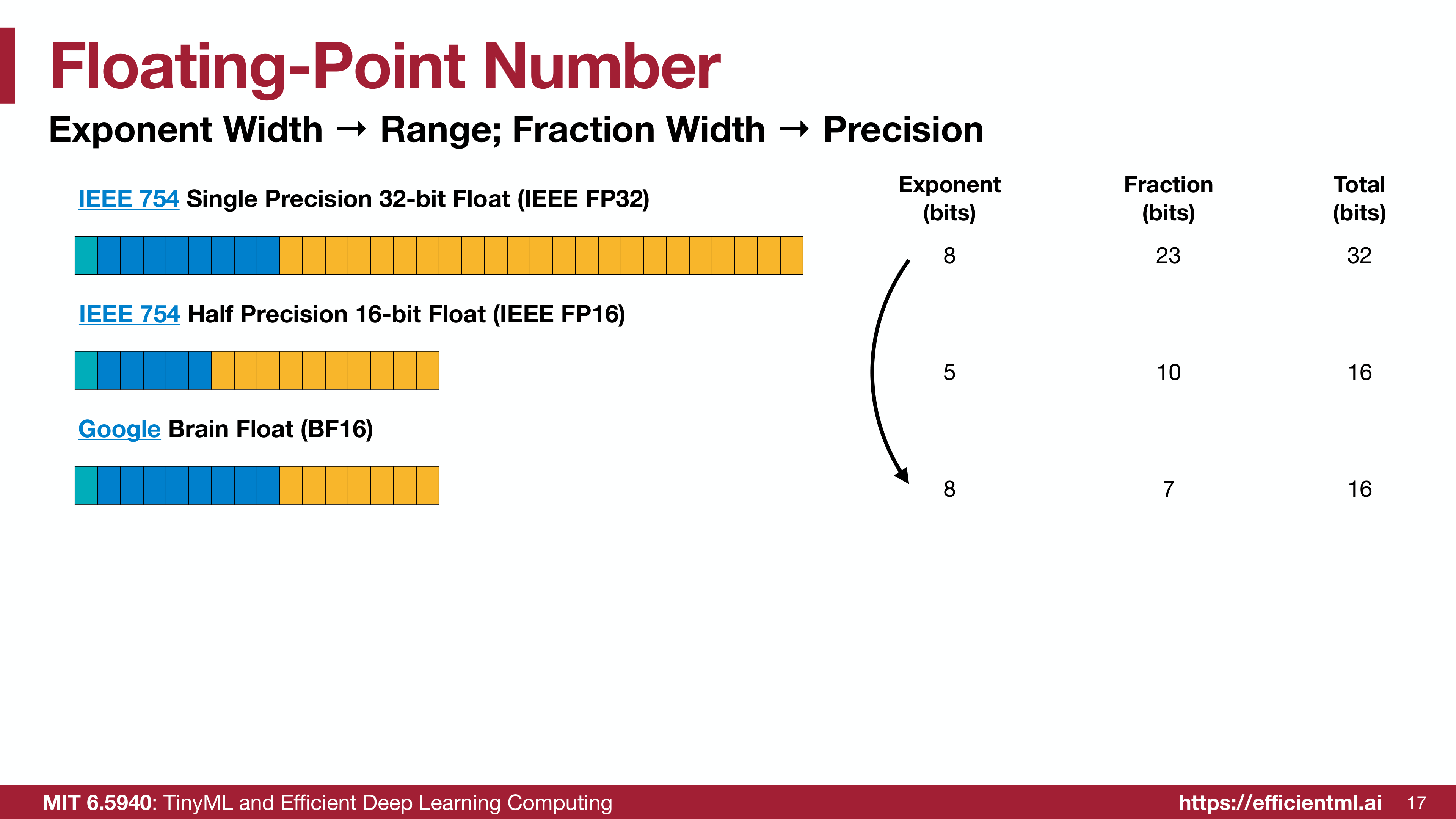 Bit allocation in various floating-point formats
IEEE FP32 (Single Precision)
With 8 exponent bits and 23 fraction bits, FP32 provides excellent range ($\pm 10^{38}$) and precision (about 7 decimal digits). It’s the default format for most neural network training.
IEEE FP16 (Half Precision)
Reducing to 5 exponent bits and 10 fraction bits, FP16 cuts memory usage in half while maintaining a reasonable range ($\pm 65,504$) and precision (about 3 decimal digits). Many modern GPUs include specialized FP16 computation units that operate twice as fast as FP32.
Brain Float 16 (BF16)
Google’s BF16 format takes a different approach: it keeps 8 exponent bits (matching FP32’s range) but reduces fraction bits to 7. This design choice proves particularly effective for deep learning, where maintaining range matters more than extreme precision. The matching exponent width allows trivial conversion between FP32 and BF16 by simply truncating the fraction.
Emerging Low-Precision Formats
Recent research explores even lower precision:
FP8 formats: NVIDIA’s FP8 comes in two variants:
- E4M3 (4 exponent, 3 fraction bits): Optimized for forward pass, maximum value of 448
- E5M2 (5 exponent, 2 fraction bits): Designed for gradients in backward pass, maximum value of 57,344
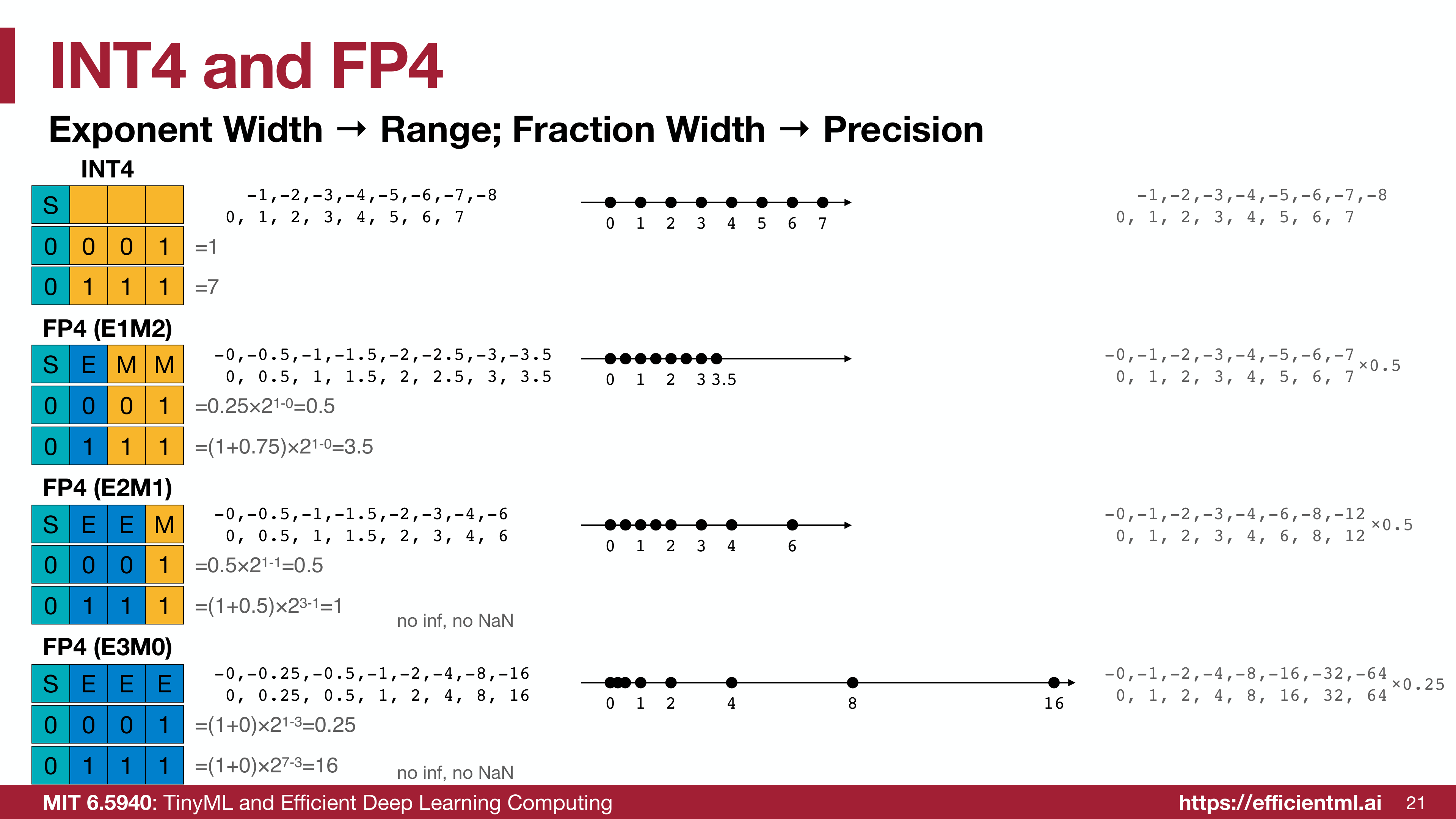 Ultra-low precision formats: INT4 and various FP4 configurations
FP4 and INT4: At 4 bits, we enter the extreme quantization territory. FP4 variants include E1M2, E2M1, and E3M0, each making different trade-offs between range and precision. INT4 simply represents integers from -8 to 7.
These ultra-low precision formats enable dramatic model compression but require sophisticated techniques to maintain accuracy.
Why Bit Width Matters for Neural Networks
The choice of numeric format impacts three critical aspects of neural network deployment:
Memory Footprint
A neural network with 100 million parameters stored in FP32 requires 400 MB of memory. Using INT8 quantization reduces this to 100 MB—a 4× reduction. This directly affects whether a model can fit in edge device memory or GPU cache.
Computational Throughput
Modern processors include specialized units for different precisions. NVIDIA’s Tensor Cores can process FP16 operations 2× faster than FP32, and INT8 operations up to 16× faster. This isn’t just marketing—the hardware truly computes more operations per cycle with lower precision.
Energy Efficiency
As we saw earlier, lower-precision operations consume dramatically less energy. For battery-powered devices, this means the difference between running inference once per hour versus once per second.
The Quantization Preview
Understanding these numeric representations reveals why quantization works: neural networks can often tolerate reduced precision without significant accuracy loss. The weights and activations don’t need FP32’s full range and precision—INT8 or even INT4 often suffices.
However, naive conversion from FP32 to INT8 doesn’t work. We need intelligent mapping strategies that:
- Preserve the information that matters most for accuracy
- Enable efficient integer arithmetic during inference
- Minimize the accuracy degradation
The next parts of this series will explore how K-means-based quantization, linear quantization, and other techniques achieve these goals.
Key Takeaways
- Lower precision means lower energy: INT8 operations consume 18.5× less energy than FP32 for multiplication
- Two’s complement enables unified hardware for signed arithmetic operations
- Floating-point formats trade off between range (exponent bits) and precision (fraction bits)
- IEEE 754 standard defines the universal format for floating-point representation
- BF16 balances range and memory efficiency, making it ideal for deep learning
- Ultra-low precision formats (FP8, FP4, INT4) enable extreme compression but require careful handling
- The quantization opportunity: Neural networks can operate with reduced precision, unlocking dramatic efficiency gains
Understanding the Landscape
With this foundation in numeric data types, you’re now equipped to understand quantization techniques. The key insight is that neural networks are remarkably resilient to reduced precision—not all 32 bits in FP32 are equally important for maintaining accuracy.
In Part 2, we’ll explore our first quantization technique: K-means-based quantization, which treats the quantization problem as a clustering challenge. This approach compresses models by grouping similar weights together while maintaining a floating-point codebook for precision.
Series Navigation:
- Part 1: Understanding Numeric Data Types (Current)
- Part 2: K-Means Based Weight Quantization
- Part 3: Linear Quantization Methods
- Part 4: Quantized Neural Network Operations
- Part 5: Post-Training Quantization Techniques
- Part 6: Quantization-Aware Training
- Part 7: Binary and Ternary Quantization
- Part 8: Mixed-Precision Quantization
References:
- MIT 6.5940: TinyML and Efficient Deep Learning Computing - EfficientML.ai Lecture 05: Quantization Part I (Fall 2024)
- Computing’s Energy Problem (and What We Can Do About it) - Mark Horowitz, IEEE ISSCC 2014
- IEEE 754 Standard for Floating-Point Arithmetic
- Neural Network Distiller: Quantization Overview